

What Does a Fractional CMO Do? A Clear Answer for Business Owners
By Don Capwell
What does a fractional CMO do? A fractional CMO leads the marketing function for a business on a part-time or contract basis. They create the marketing strategy, guide the people doing the work, manage vendors and agencies, set priorities, track the right numbers, and make sure marketing activity is connected to revenue instead of floating around as a pile of disconnected tasks.
That is the simple answer.
But if you are a business owner, the simple answer probably only gets you halfway there. You are not asking because you want a new title explained to you. You are asking because something in your marketing feels harder, messier, or more expensive than it should, and you are trying to figure out what this person actually does once they step inside the business.
TL;DR
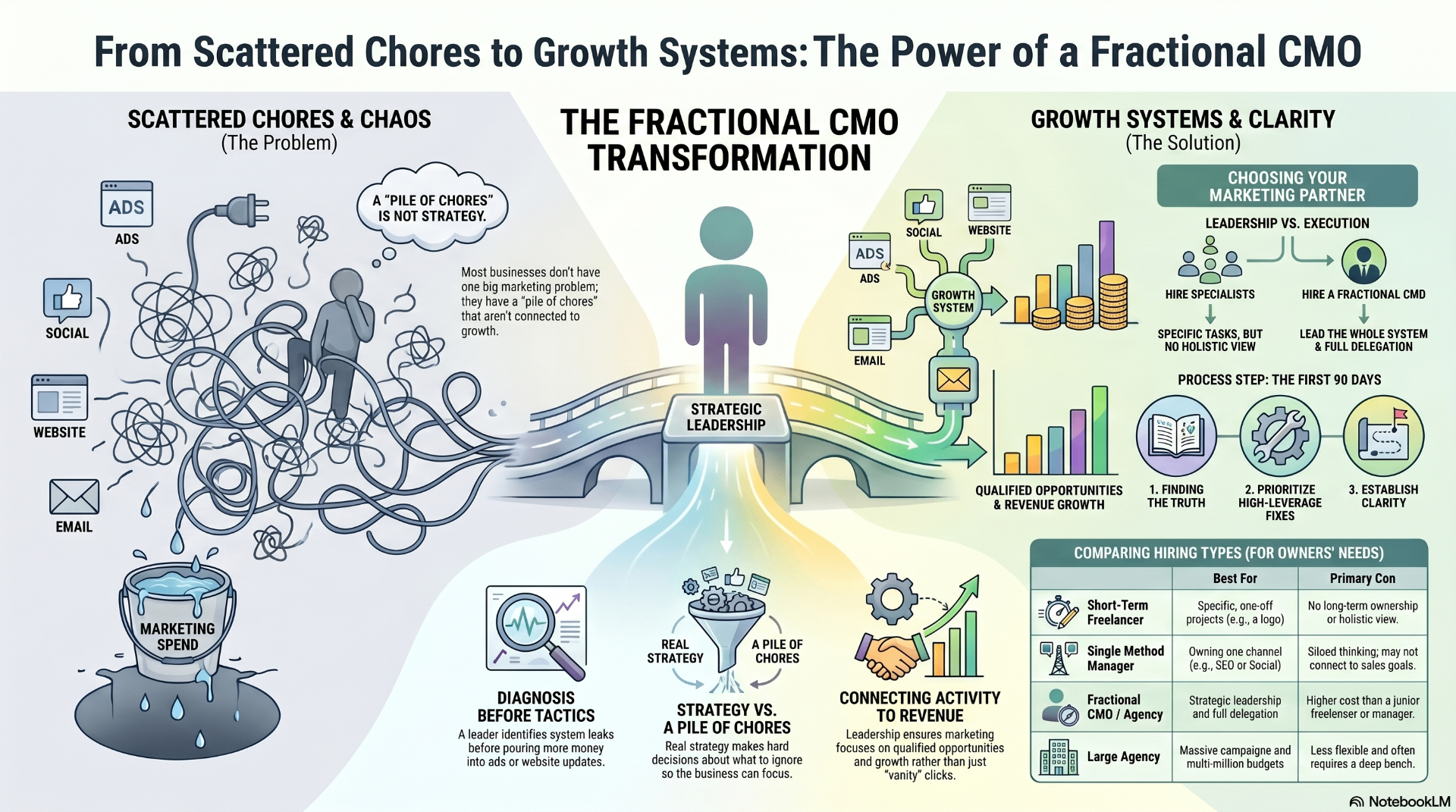
What does a fractional CMO do? A fractional CMO helps a business turn scattered marketing into a clear, practical growth system. They look at the whole machine, including the offer, message, audience, sales process, vendors, budget, reporting, follow-up, CRM, automation, and retention. Their job is not to create more random marketing activity. Their job is to help the business make better decisions, focus on what actually drives growth, and hold the marketing system accountable.
A Fractional CMO Looks at the Whole Marketing System
Most businesses do not have one big marketing problem. They usually have a series of smaller problems that have been allowed to stack on top of each other until nobody knows where the real issue begins.
The website may look fine, but the message might be too generic to make the right person care. The ads may be getting clicks, but the offer may not be strong enough to make people act. The SEO company may be reporting more traffic, but that traffic may not be turning into qualified opportunities. Leads may be coming in, but the follow-up may be slow, inconsistent, or impossible to track. The CRM may be full of names and stages, but if the data behind it is sloppy, the reports are not telling the truth.
That is why a fractional CMO should not walk into a business and start throwing tactics at the wall. The first job is not more activity. The first job is diagnosis.
They need to look at the whole path from the moment someone first discovers the business to the moment that person becomes a customer. How are people finding you? What do they see first? What do they believe about you before they ever call? What are they being asked to do? What happens when they raise their hand? Who follows up? How fast? What is said? What gets tracked? What turns into revenue? What gets lost before anyone notices?
Those questions are where the truth starts to show up.
A lot of business owners think they need more leads when the real problem is that the leads they already paid for are not being handled correctly. Others think they need a new website when the real problem is that the offer is weak. Others blame the agency, when the agency may be doing exactly what it was asked to do, even though nobody has stopped long enough to ask whether that is still the right thing.
That is where a fractional CMO earns their keep. They help the business find the leaks before more money gets poured into the machine.
A Fractional CMO Builds Strategy, Not a Pile of Marketing Chores
Strategy is one of those words that gets used so much it almost stops meaning anything. In too many businesses, strategy really means a list of things someone thinks should be done next.
Run more ads. Post more content. Fix SEO. Build a funnel. Send emails. Start using AI. Make videos. Update the website. Launch a newsletter. Try LinkedIn. Try TikTok. Try webinars. Try everything.
That is not strategy. That is a pile of chores.
A real marketing strategy makes decisions. It decides who the business is trying to reach, what problem it wants to be known for solving, why the buyer should care, what offer is strong enough to create action, what channels deserve focus, what message needs to be repeated, and what should be ignored for now.
That last part matters.
A business can drown in good ideas. It can spend money, time, and energy on things that are not foolish by themselves, but still wrong for this stage of the business. A fractional CMO should help decide what matters now, what can wait, and what needs to be cut completely.
That is not always the fun part of marketing, but it may be the most valuable part.
Most business owners do not need more people bringing random ideas into the room. They need someone who can look at the ideas already on the table and say, "This one matters, this one can wait, and this one is a distraction wearing a nice shirt."
That kind of clarity saves money.
A Fractional CMO Connects Marketing to Revenue
Marketing cannot live in its own little bubble. It has to connect to revenue, or the business owner is left staring at reports that sound impressive but do not answer the only question that really matters.
Is this helping the business grow?
Clicks can matter, but clicks are not the goal. Impressions can matter, but impressions are not the goal. Traffic can matter, but traffic is not the goal. Even leads are not the final goal, because a lead that never books, never shows up, never qualifies, never buys, or never comes back is not the same thing as growth.
A fractional CMO should care about what happens after the lead comes in. Do people book? Do they show up? Are they qualified? Do they buy? Do they become good customers? Do they refer? Do they leave reviews? Do they return?
This is where a lot of marketing gets uncomfortable, because the problem may not be the campaign. The campaign may be doing its job. The business may be losing the opportunity after the click, after the form fill, after the call, or after the first conversation.
If you are paying for leads but nobody responds for three hours, that is not just a lead problem. If people are booking calls but not showing up, that is not just an ad problem. If sales says the leads are bad, but nobody is recording calls, tracking outcomes, or measuring speed to lead, that is not reporting. That is guessing.
A good fractional CMO helps get the business out of guessing mode.
They help define the numbers that matter. Not every number. The right numbers. For one business, that may be booked appointments. For another, it may be cost per qualified opportunity. For another, it may be revenue by source, close rate, show rate, speed to lead, lifetime value, or repeat purchase rate.
The right numbers depend on the business, but the principle does not change. If the number does not help the owner make a better decision, it should not be allowed to dominate the conversation.
A Fractional CMO Leads the People Doing the Work
A fractional CMO is not usually hired to replace every agency, vendor, or internal team member. They are hired to lead the marketing function so those people are working toward the same outcome.
That distinction matters.
An ad agency may be very good at paid traffic. An SEO company may be very good at rankings. A web designer may be very good at making the site look professional. A social media person may be very good at creating content. A CRM person may be very good at building automations.
But if nobody is leading the whole system, everyone can be doing their job while the business still loses.
The ad agency optimizes for cost per lead. The SEO company optimizes for traffic and rankings. The web designer optimizes for appearance. The social media person optimizes for engagement. The CRM person optimizes the workflow. The owner wants revenue.
Those are not always the same game.
A fractional CMO makes sure everyone is playing the right game.
They give vendors clearer direction. They ask better questions. They hold people accountable. They make sure the work being done actually connects to the business goal. They also help internal marketing people perform better because the team finally has priorities, structure, and leadership.
This is especially important when a business has a marketing manager who is expected to be everything at once. In many companies, that person is expected to coordinate campaigns, write copy, manage vendors, understand analytics, update the website, handle social media, fix the CRM, create reports, manage projects, and somehow also think like an executive.
That is not a reasonable job description. That is how good people get overwhelmed.
A fractional CMO can give that person the direction and support they need, while keeping the owner from becoming the default marketing leader by accident.
A Fractional CMO Helps Decide What to Stop Doing
One of the most valuable things a fractional CMO can bring into a business is the willingness to stop feeding what is not working.
That sounds simple, but it is not how most marketing conversations go. Most marketing conversations are about adding something. Add another campaign. Add another channel. Add more content. Add more software. Add more automation. Add more reporting. Add more meetings.
Sometimes the business does need to add something.
But often, the fastest path to better marketing is subtraction.
Stop chasing the wrong buyer. Stop spreading the budget across five weak channels. Stop running ads to a weak offer. Stop measuring numbers that do not help anyone make a decision. Stop posting content nobody cares about. Stop letting every vendor define success inside their own lane. Stop treating slow follow-up like a small operational issue when it is probably costing real money.
A business owner needs someone in the room who can say those things without being tied emotionally to every existing project.
That is not always comfortable. Owners have pet ideas. Teams have projects they like. Vendors have services they want to protect. Everyone can make a case for why something should continue.
But marketing leadership is not about keeping every idea alive.
It is about making the business grow.
What a Fractional CMO Should Do in the First 90 Days
The first 90 days should not feel mysterious. Growth may take time, but clarity should start quickly.
In the first 30 days, a fractional CMO should be finding the truth. They should review the website, the offers, the ads, the SEO, the CRM, the reporting, the vendors, the sales process, the follow-up, and the customer journey. They should talk to the owner, listen to sales, look at what past customers actually bought, and study what happens between first contact and closed deal.
The goal of that first month is not to create a beautiful strategy document that dies in a folder. The goal is to understand what is really happening.
By the end of that first stretch, the owner should have a clearer picture of what is working, what is not working, where money is being wasted, and where the biggest opportunities are hiding.
The next step is prioritization. Not everything can be fixed at once. Not everything deserves attention. Some problems are urgent. Some are expensive. Some are annoying, but not actually important. Some are symptoms of something deeper.
A fractional CMO should help the business decide what gets fixed first because it creates the most leverage. Maybe the offer needs to be sharpened before the ads are scaled. Maybe the CRM needs to be cleaned up before the reports can be trusted. Maybe speed to lead needs to be fixed before anyone keeps blaming lead quality. Maybe the website message needs to be rewritten before another dollar is spent sending traffic to it.
By days 60 to 90, the business should begin to feel clearer and more focused. The team should know what matters. Vendors should have better direction. Reporting should be more useful. The owner should not be buried under random marketing decisions. The highest-impact fixes should be moving, and the business should have a stronger sense of where growth is supposed to come from.
That is what a good first 90 days should create.
Clarity first. Then focus. Then execution. Then growth.
Fractional CMO vs Agency, Consultant, or Marketing Manager
A fractional CMO is different from an agency, consultant, or marketing manager, even though those roles can overlap in the mind of a business owner.
An agency usually executes a specific part of marketing. They may run ads, manage SEO, build websites, create content, handle email, or manage social media. A consultant usually gives advice on a specific problem or opportunity. A marketing manager usually coordinates execution inside the company.
A fractional CMO leads the marketing function.
That means they are responsible for the bigger picture. They decide what should be done, why it matters, who should do it, how it connects to the business goal, and how success should be measured.
That does not make the fractional CMO better than the other roles. It means the role is different.
If you already know exactly what needs to be done and you simply need someone to execute it, hire the right specialist. If you need one specific problem diagnosed, a consultant may be enough. If you need someone to coordinate daily marketing tasks, a marketing manager may be the right hire.
But if the business has activity without direction, vendors without alignment, reports without clarity, or growth goals without a real plan, that is when the difference becomes clear. The fractional CMO is not just another person doing marketing work. They are the person responsible for making the marketing work make sense.
Why AI and Automation Now Belong in the Conversation
A modern fractional CMO should understand AI, automation, CRM systems, lead routing, follow-up workflows, reporting, and customer data. Not because every business needs to chase the newest tool, but because marketing operations have changed.
AI can help a business respond faster, qualify leads, book appointments, summarize calls, support content, reactivate old opportunities, improve reporting, and reduce manual work. Automation can help make sure leads are followed up with, reminders are sent, opportunities are not forgotten, and customers are asked for reviews at the right time.
But AI and automation can also make a mess move faster.
If the business does not know who it wants to reach, what it wants to say, what action it wants the prospect to take, or what the sales process should look like, technology will not fix the problem. It will usually expose it.
That is why the fractional CMO should not just ask, "What tools are we using?" They should ask, "What outcome are we trying to create, and does this tool help us get there?"
The goal is not to use AI. The goal is to improve the business.
If AI helps the company respond to leads faster, recover missed opportunities, improve customer experience, and make better decisions, then it matters. If it only helps publish more generic content nobody reads, it is just another distraction.
The Real Job of a Fractional CMO
The real job of a fractional CMO is to make marketing make sense.
That may not sound as exciting as promising some magic new growth trick, but most business owners do not need magic. They need clarity. They need leadership. They need someone who can look at the website, the ads, the SEO, the CRM, the sales process, the offers, the vendors, the follow-up, the reporting, and the customer journey and say, "Here is what is actually happening, and here is what we need to do next."
That is the value.
Need help with your marketing? If you are in Mesa, Gilbert, Tempe, Scottsdale, Queen Creek, Apache Junction, or San Tan Valley, email us or book a free strategy session and let's talk about what is actually happening in your business.
A fractional CMO helps the business stop guessing. They help turn scattered marketing activity into a focused growth system. They help the owner know what to fix, what to measure, what to stop, where to spend, and how to connect marketing activity to revenue.
Because at the end of the day, that is the question that matters.
Is your marketing helping the business grow?
A good fractional CMO helps you answer that question clearly.
Then they help you do something about it.
Want help putting this into action?
Book a free strategy session and let's map out your next move.
Book a Strategy Session Now