

Should I Hire a Fractional CMO? How to Know if You Need Marketing Leadership
By Don Capwell
Should I hire a fractional CMO? The answer is yes if your business needs senior marketing leadership, but not necessarily a full-time executive. More specifically, you should consider hiring a fractional CMO when marketing feels scattered, your team or vendors are staying busy but not aligned, the owner is still making too many marketing decisions, and nobody can clearly connect marketing activity to revenue.
That is the direct answer.
But the better answer is this: you should hire a fractional CMO when the real problem is no longer execution. It is leadership.
That distinction matters because a lot of business owners misdiagnose this problem. They think they need more leads, a better agency, a new website, stronger SEO, more social media, better ads, a better CRM, or some new AI tool that promises to fix the mess. Sometimes one of those things is true. But sometimes the business already has enough pieces on the board. The problem is that nobody is leading the whole thing.
TL;DR
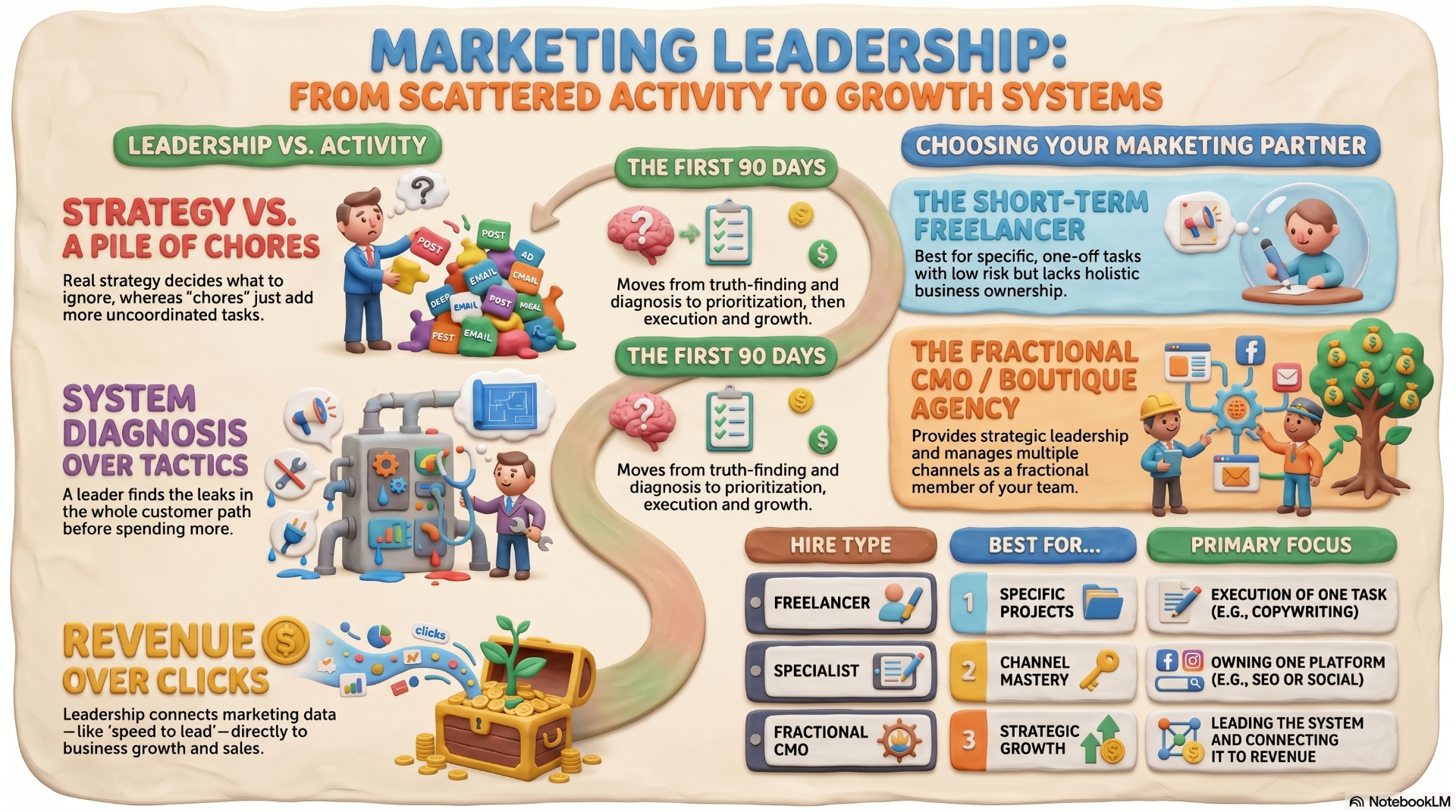
Should I hire a fractional CMO? It depends on whether your problem is marketing activity or marketing leadership. If you only need a task done, hire a specialist. If you need one campaign fixed, hire an expert. If you need daily coordination, hire a marketing manager. But if you have a website, ads, SEO, content, vendors, CRM, follow-up, reporting, and budget decisions that are not working together as one clear growth system, a fractional CMO may be the right move. The real value is not more marketing ideas. It is clarity, leadership, accountability, and better decisions tied to revenue.
The First Question Is Not Whether You Need More Marketing
Most business owners do not start thinking about a fractional CMO because marketing is completely absent. They start thinking about it because marketing is happening, but it does not feel controlled.
That is an important difference.
If there is no website, no campaigns, no messaging, no follow-up, no CRM, no vendors, no content, and no real marketing foundation, then the business may just need to build the basics. But most businesses asking this question are not sitting at zero. They have already spent money. They have already hired people. They have already tried things. They may even have a team or agency that is doing what it was asked to do.
And yet the owner still feels like the whole thing is harder to understand than it should be.
The agency says leads are coming in. Sales says the leads are weak. The SEO company says traffic is improving. The owner wants to know why revenue is not moving. The CRM has data, but nobody really trusts it. The website looks fine, but the message sounds like everyone else. There are reports, meetings, opinions, and recommendations, but not enough clarity.
That is usually not a marketing activity problem.
That is a leadership problem.
A fractional CMO is meant for that kind of situation. Their job is not to walk in and throw another pile of tactics on the table. Their job is to step back, look at the whole system, and help the business understand what is actually happening.
You May Need One if the Owner Is Still the Marketing Leader by Default
One of the clearest signs that a fractional CMO might make sense is when the owner is still the unofficial head of marketing.
Nobody may have given the owner that title, but the business proves it every week. The owner approves the ads, rewrites the copy, tells the agency what to change, decides which campaign to run, argues with the web person, checks the CRM, asks why leads are down, and tries to figure out whether the SEO report means anything.
That can work in the early days because the owner is close to everything. The owner knows the customer, understands the offer, feels the pressure, and usually has the strongest instincts in the room.
But there comes a point where that same strength becomes a bottleneck.
The owner cannot keep running the business and also serve as the strategist, copy reviewer, campaign director, vendor manager, data analyst, sales alignment person, and final decision-maker for every marketing question. At some point, the business either gets real marketing leadership or the owner keeps getting dragged into tactical decisions that should not be sitting on their desk anymore.
That is where a fractional CMO can create immediate value.
Not because the owner stops caring about marketing. That would be a mistake. The owner should still care deeply. But the owner should not have to be the only adult in the room trying to connect every marketing decision to the business model.
You May Need One if Your Vendors Are Busy, but Not Aligned
This is one of the most common situations.
The business has an ad agency. It has an SEO company. It has a website person. It may have someone writing emails, managing social media, building automations, or creating content. Each person may be competent, and each person may be doing the thing they were hired to do.
But nobody is responsible for the whole picture.
That is where things get expensive.
The ad agency optimizes for cost per lead. The SEO company optimizes for rankings and traffic. The web designer optimizes for appearance. The CRM person optimizes workflows. The social media person optimizes engagement. The owner wants revenue.
Those are not always the same game.
A fractional CMO makes sure everybody is playing the right game. They help define the outcome, set the priorities, guide the vendors, ask better questions, and hold people accountable for work that connects to the business goal instead of just the vendor's report.
This does not mean your vendors are bad. In many cases, the vendors are doing exactly what they were hired to do. The issue is that nobody is leading them from the business side.
A fractional CMO gives those vendors a strategic point of contact who understands marketing well enough to direct the work and business well enough to know whether it matters.
You May Need One if You Have Leads, but Not Enough Truth
A lot of businesses think they have a lead problem when they actually have a truth problem.
They know how many leads came in. Maybe. They know what the agency reported. Maybe. They know what sales said about the leads. Maybe. But they do not know what actually happened from first click to closed deal.
That is dangerous because the business starts making decisions based on fragments.
If leads are down, spend more. If lead cost is up, blame the platform. If sales complains, blame the agency. If the agency pushes back, blame the landing page. If the landing page looks fine, blame the offer. Around and around it goes, with everyone defending their corner and nobody seeing the whole path clearly.
A fractional CMO should help the business get out of that fog.
They should be asking better questions. What happened after the lead came in? How fast was the follow-up? Was the lead qualified? Did they book? Did they show? Did sales speak to them? Was the call recorded? What was the objection? Did they buy? If they did not buy, why not? If they did buy, where did they come from, and what made them different?
Those questions matter because marketing does not stop when the lead arrives. In many businesses, that is exactly where the money starts leaking.
If the business is paying for leads but responding too slowly, that is not just a marketing problem. If leads are booking but not showing, that is not just an ad problem. If sales says the leads are bad but nobody is tracking the calls, that is not reporting. That is guessing with a spreadsheet nearby.
A fractional CMO should bring the business closer to truth.
You May Need One if Marketing Has No Clear Order of Operations
A business can waste a lot of money doing the right things in the wrong order.
That sounds simple, but it happens constantly. The business scales ads before fixing the offer. It rebuilds the website before clarifying the message. It hires an SEO company before deciding which services it actually wants to be known for. It adds automation before cleaning up the sales process. It creates more content before understanding what the buyer needs to believe before they act.
Each move may sound reasonable by itself. But the order is wrong.
A fractional CMO should know how to sequence the work.
That does not mean they have some magic formula that fits every business. It means they know the difference between a root problem and a symptom. If the offer is weak, more traffic will expose that weakness faster. If the CRM data is sloppy, better reports will not create better decisions. If sales follow-up is slow, better lead generation may just create more missed opportunities. If the message is unclear, publishing more of it will only spread the confusion.
The order matters because the budget is not unlimited, the team is not unlimited, and the owner's patience is not unlimited either.
A good fractional CMO helps decide what gets fixed first because it creates the most leverage.
You May Need One if Your Marketing Manager Is Being Asked to Think Like a CMO
This one is common, and it is not fair to the marketing manager.
A business hires a smart, capable marketing person and then slowly turns that person into the entire marketing department. They are expected to manage campaigns, coordinate vendors, write content, update the website, understand analytics, fix the CRM, manage social media, build reports, support sales, come up with strategy, and somehow know which decisions should drive the next stage of growth.
That is not a job description.
That is a stress test.
A marketing manager may be excellent at execution and coordination, but that does not automatically make them a senior marketing executive. Those are different roles. One keeps the work moving. The other decides what work should matter in the first place.
A fractional CMO can be the leadership layer above that person. They can set direction, define priorities, mentor the internal team, manage vendors, and help the marketing manager become more effective instead of more overwhelmed.
That can be a strong model for an owner-led business because it does not require blowing up the team. It gives the team better leadership.
You May Need One if Growth Has Stalled and Nobody Can Explain Why
Stalled growth is one of the obvious signs people talk about, but the important part is not just that growth has stalled. The important part is that nobody can explain why with enough clarity to know what to do next.
If growth has stalled because the market dried up, that is one kind of problem. If growth has stalled because the offer is weak, that is another. If growth has stalled because leads are not being followed up with, that is another. If growth has stalled because competitors are positioning themselves better, that is another. If growth has stalled because the business is trying to sell too many things to too many people, that is another.
The words "growth has stalled" do not tell you enough.
A fractional CMO should help diagnose the reason behind it.
That diagnosis matters because the wrong fix can make the problem more expensive. More ad spend will not solve weak positioning. A new website will not fix bad follow-up. More content will not solve an unclear offer. A new agency will not help if the business keeps giving agencies the wrong target.
Before the business pours more money into growth, someone needs to understand why growth is stuck.
You May Need One if AI and Automation Are Creating More Noise Than Progress
This is one of the newer signs, and most older articles on this topic do not treat it seriously enough.
A lot of businesses are now adding AI and automation into their marketing without first fixing the thinking underneath it. They add chatbots, workflows, content tools, call summaries, lead routing, automated follow-up, AI email, AI social posts, and AI reporting. Some of those things can be extremely useful. Some can create real speed. Some can save money and recover opportunities that used to disappear.
But AI can also help a business make a mess faster.
If the message is unclear, AI can create more unclear messaging. If the offer is weak, automation can deliver that weak offer more efficiently. If the sales process is sloppy, automated follow-up can make the sloppiness feel polished while still failing to convert. If nobody knows what numbers matter, AI reporting can create beautiful dashboards that still do not answer the real question.
The goal is not to use AI.
The goal is to improve the business.
A modern fractional CMO should understand that distinction. They should be able to look at AI, automation, CRM, lead response, database reactivation, customer follow-up, review requests, reporting, and sales handoff as part of the same growth system. They should know where technology can help, where it will create noise, and where the business needs clarity before any tool is worth adding.
That matters because the businesses that win with AI will not be the ones using the most tools. They will be the ones using the right tools against the right problems.
You May Not Need a Fractional CMO if the Problem Is Narrow
This article is not about talking every business owner into hiring one.
Sometimes the answer is no.
If the problem is narrow, hire for the narrow problem. If you need a landing page, hire someone who builds landing pages. If you need Google Ads fixed, hire a strong Google Ads specialist. If you need email copy, hire a copywriter. If you need someone to post consistently on social media, hire that person. If you need one strategic question answered, a consultant may be enough.
A fractional CMO makes the most sense when the problem crosses multiple areas of the business and needs leadership, not just labor.
That is the line.
If the work is obvious and you simply need someone to do it, you may not need a fractional CMO. If the work is not obvious, the priorities are not clear, the vendors are not aligned, the numbers are not trusted, and the owner is still the person trying to make sense of all of it, then you are probably looking at a leadership gap.
That is the problem a fractional CMO is built to solve. If you want a deeper look at the role itself, read what a fractional CMO actually does day to day.
The Better Question
The question is not really, "Should I hire a fractional CMO?"
The better question is, "What problem am I actually trying to solve?"
If the problem is lack of execution, hire execution. If the problem is one broken campaign, hire someone who knows that campaign. If the problem is poor coordination, hire or strengthen the manager. But if the problem is that marketing has become too important, too expensive, or too scattered to keep managing by instinct, then the answer changes.
At that point, the business does not just need more marketing.
It needs marketing leadership.
That is where a fractional CMO can be the right move. Not because the title is impressive, and not because every business needs one, but because the business has reached a point where scattered activity is costing more than leadership would.
And that is usually the moment when the owner knows it, even before they can name it.
The reports are not enough anymore. The vendor calls are not enough. The random ideas are not enough. The owner does not need more motion. They need someone who can look at the whole system and say, "Here is what is happening, here is what matters, here is what we fix first, and here is how we know if it worked."
That is the real reason to hire a fractional CMO.
Not to make marketing busier.
To make marketing make sense.
Wondering if it's the right move for your business? Serving Mesa, Gilbert, Tempe, Scottsdale, Queen Creek, Apache Junction, and San Tan Valley - email us or book a free strategy session and let's figure it out together.
Want help putting this into action?
Book a free strategy session and let's map out your next move.
Book a Strategy Session Now